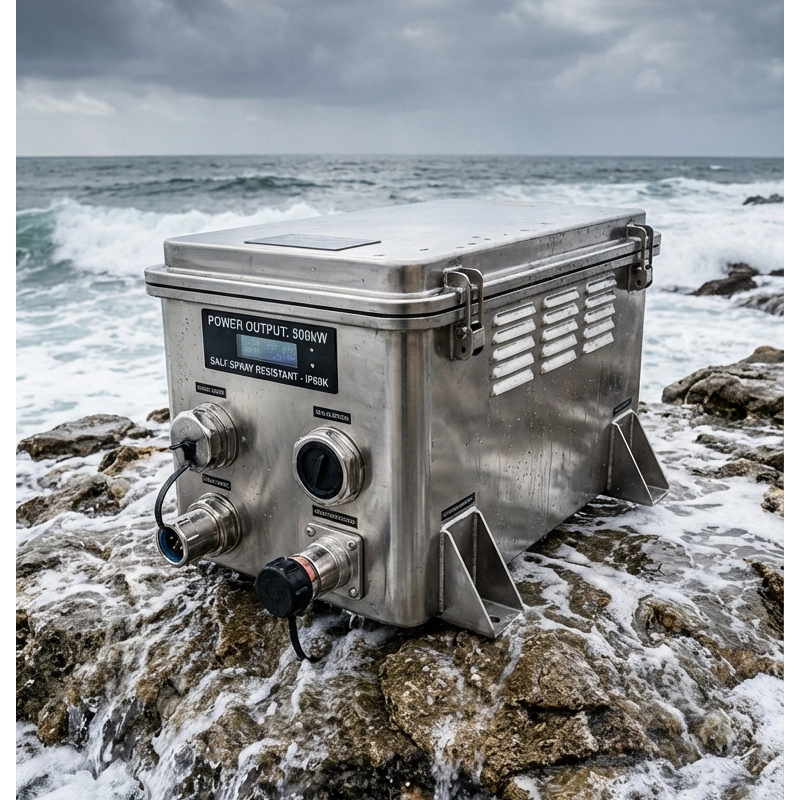
tandard industrial-grade energy storage power supplies often face issues such as hull corrosion, terminal oxidation, PCB board erosion, and rapid capacity degradation of battery cells in coastal environments within just 1 to 2 years. These problems can even cause safety accidents like short circuits and fires. This not only significantly increases maintenance and replacement costs but also directly threatens the safety and continuity of power supply in coastal production, daily life, and maritime operations. The Leiener High-Performance Salt-Spray Resistant Energy Storage Power Supply, specially designed for extreme coastal environments, is the core solution to solve this industry pain point. With its full-link corrosion protection design, adaptability to extreme environments, and high-reliability safety system, it redefines the energy storage standards for coastal and maritime scenarios.
I. Extreme Coastal Environments: Four Deadly Challenges for Energy Storage Systems
The destructive power of coastal environments is far more than just “humidity”. With salt-spray corrosion as the core, multiple composite extreme conditions erode the energy storage system comprehensively from the inside to the outside, which is the fundamental reason why ordinary energy storage products cannot operate stably for a long time.
1. Salt-Spray Corrosion: A Penetrating Electrochemical “Killer”
The sodium chloride salt spray prevalent in coastal atmosphere is mainly harmful due to chloride ions. These charged particles, with a particle size of only nanometers, are extremely penetrative and adsorptive. They can easily penetrate ordinary metal plating, sealing strips, and even basic three-proof coatings, and undergo electrochemical reactions with metal materials, causing pitting corrosion, crevice corrosion, and stress corrosion cracking.
- For Electrical Systems: Corrodes copper foil on PCBs, component leads, and wiring terminals, leading to a sharp increase in contact resistance, signal interruption, and even short circuits;
- For the Battery Itself: Corrodes cell casings, lugs, and connection bars, causing cell liquid leakage, abnormal increase in internal resistance, irreversible capacity degradation, and directly triggering thermal runaway in severe cases;
- For Structural Components: Ordinary 304 stainless steel and carbon steel casings often show obvious corrosion in coastal environments within 6 to 12 months. Once the sealing structure fails, salt spray directly invades the equipment, causing irreversible damage.
2. Synergistic Damage Effect of High Humidity and High Temperature
In global core coastal areas, the annual relative humidity remains above 85%, and the extreme humidity in summer can reach 99%, accompanied by high temperature exposure above 40°C. The synergistic effect of high humidity and high temperature forms a “condensation effect”. Water vapor condenses into a water film on the surface of components inside the equipment, combining with salt spray to form a conductive electrolyte, which significantly accelerates the corrosion process. Meanwhile, high humidity environment greatly reduces the insulation performance of the equipment, causing leakage and grounding faults; the growth of mold further damages the circuit and component structure.
3. Superimposed Impact of Extreme Weather
Coastal areas are high-incidence regions for typhoons, rainstorms, thunderstorms, and storm surges, which put extreme requirements on the mechanical performance, protection capability, and anti-interference ability of energy storage systems: strong winds and continuous vibrations brought by typhoons cause loose connections and structural deformation of equipment; frequent lightning activities generate surge overvoltage, damaging electrical components; rainstorms and sea spray further increase the risk of water ingress and corrosion. Ordinary energy storage products often become completely ineffective after one extreme weather event.
4. Operation and Maintenance Dilemmas in Remote Areas
Most coastal energy storage application scenarios are distributed in remote islands, offshore platforms, remote coastal base stations, unmanned marine monitoring stations, and other areas far from the inland. Transportation is extremely inconvenient. A single operation and maintenance requires renting ships and professional equipment, with extremely high manpower and time costs. Even some islands are not navigable during typhoon seasons. Frequent fault warnings and component replacement requirements of ordinary energy storage products will cause operation and maintenance costs to rise exponentially, ultimately leading to a significant reduction in the full-life cycle income of the project.
II. Why Can’t Ordinary Energy Storage Power Supplies Adapt to Extreme Coastal Environments?
Many users have a misunderstanding: they think that an energy storage power supply with only IP65 protection grade can cope with salt-spray environments. In fact, IP protection only blocks the intrusion of solid dust and liquid water, and has almost no defense capability against nanometer-level chloride ion salt spray. The design logic of ordinary energy storage products is based on the normal temperature and dry industrial environment, and has three fundamental defects in the field of salt-spray resistance:
First, lack of systematic anti-corrosion design. Ordinary energy storage products mostly adopt ordinary carbon steel or 304 stainless steel casings with only basic painting treatment. The coating thickness is insufficient and the adhesion is poor, which can be easily penetrated by chloride ions. PCBs are only coated with a single layer of simple three-proof paint, and key components have no potting protection. Wiring terminals adopt ordinary copper parts without nickel-gold plating anti-corrosion layer, which will quickly oxidize and fail in salt-spray environments.
Second, insufficient environmental adaptability design. The working temperature range of ordinary energy storage power supplies is mostly 0-40°C, which cannot adapt to the high temperature in summer and low temperature in winter in coastal areas. The insulation design only meets the basic standards, and the insulation resistance drops rapidly in high humidity environments, easily causing leakage faults. Without professional anti-vibration and lightning protection designs, it cannot withstand the impact of extreme weather such as typhoons and thunderstorms.
Third, no targeted test and certification system. Ordinary energy storage products only conduct basic performance and safety tests, and rarely carry out professional salt-spray tests. Even if salt-spray tests are carried out, they are mostly basic 48-hour and 96-hour tests, which cannot simulate the medium and long-term salt-spray erosion in coastal environments. Moreover, they cannot pass the maritime classification society certification and marine environmental adaptability certification, and cannot meet the compliance requirements of professional scenarios such as ships and offshore platforms.
III. Core Technical System of High-Performance Salt-Spray Resistant Energy Storage Power Supply
A salt-spray resistant energy storage power supply truly adapted to extreme coastal environments is by no means a simple “thickened casing + paint upgrade”. It is a full-link anti-corrosion and high-reliability design system from cell level to system level, from material selection to structural design, and from electrical performance to intelligent management. The core technologies cover four dimensions:
1. Full-Link In-Depth Salt-Spray Corrosion Protection Design
This is the core capability of salt-spray resistant energy storage power supplies. It adopts a 纵深 defense concept of “layered protection from the inside out” to completely block the erosion path of chloride ions.
- Cell-Level Anti-Corrosion: Laying the Foundation for the Energy CoreSelect high-stability lithium iron phosphate battery cells. The cell casing is made of corrosion-resistant 316L stainless steel or high-strength anodized aluminum alloy, and hermetically sealed by laser welding to prevent salt spray and water vapor from invading the cell. The lugs are made of nickel-plated copper composite materials, which are passivated and anti-corrosive on the surface to avoid electrochemical corrosion during charging and discharging. The electrolyte adopts a high-stability formula with anti-corrosion additives, which maintains chemical stability even in extreme environments and greatly reduces the risk of liquid leakage.
- PACK and Structural-Level Anti-Corrosion: Building a Strong Casing Isolating CorrosionThe main equipment casing is 优先 made of 316L marine-grade stainless steel. Its molybdenum content can greatly improve the corrosion resistance to chloride ions, and its salt-spray resistance is more than 3 times that of 304 stainless steel. It has extremely strong weather resistance and corrosion resistance, and can withstand long-term erosion by ultraviolet rays, salt spray, and acids and alkalis.The sealing structure adopts marine-grade silicone rubber sealing rings, which have a temperature resistance range of -60°C to +200°C, are anti-aging and salt-spray resistant, and have a service life of more than 10 years. The equipment seams adopt a labyrinth sealing structure + double sealing ring design, combined with the highest IP67 or even IP68 protection grade, which can completely block the intrusion of salt spray, water vapor, and sea spray. Even in short-term water immersion, the internal equipment can remain undamaged.
- Electrical Connection-Level Anti-Corrosion: Guarding the Key Nodes of Current TransmissionElectrical connections are the hardest hit areas for salt-spray corrosion. All wiring terminals adopt a copper matrix + nickel plating double composite plating layer, with contact resistance as low as the milliohm level. At the same time, they have extremely strong corrosion resistance to avoid heating and open circuit faults caused by oxidation. Power connection bars adopt tinned copper bars or aluminum bars, which are covered with insulation and anti-corrosion treatment. All wiring harnesses adopt marine-grade cross-linked polyethylene (XLPE) insulated cables, and the conductors are tinned oxygen-free copper wires. The joints adopt double treatment of heat shrinkable tube sealing + epoxy resin potting to completely isolate salt spray and water vapor.
- PCB Board-Level Anti-Corrosion: Protecting the Nerve Center of the Control SystemThe core PC boards of the BMS (Battery Management System), inverter, and communication module all adopt a “three-time three-proof coating” process. First, apply acrylic primer to achieve basic protection, then apply polyurethane coating to improve adhesion and corrosion resistance, and finally apply silicone nanocoating to achieve ultimate water repellent and salt-spray resistance. The total coating thickness is ≥150μm. For key components such as CPU, relays, and connectors, epoxy resin overall potting treatment is adopted to completely isolate from the external environment, avoiding short circuits and corrosion faults even if salt spray and condensation attach to the PCB surface.
Frequently Asked Questions (FAQ)
Can you customize energy storage power supplies for coastal environments?
Yes. We offer tailored battery solutions. Leinenr Power (Zibo) Technology Co., Ltd provides customized battery solutions to meet your specific requirements, including custom voltage and capacity.